
Observe from above
A UAV gathers visible-light and thermal imagery to screen candidate areas and provide geographic context. An aerial anomaly is a lead for review, not a confirmed hazard.
Output: georeferenced candidate observations

Civilian · Research concept
An electric ground platform concept connecting aerial observation, humanitarian survey, and agricultural recovery.
AI-generated Concept A packaging visualization. The revised vehicle configuration remains under study; not a field demonstration.
A civilian purpose
Land recovery requires more than a map. It needs traceable observations, qualified decisions, and a practical path toward useful soil and productive farms.
Edison Aerospace is exploring a coordinated unmanned aerial vehicle (UAV) and unmanned ground vehicle (UGV) workflow. A proposed high-clearance electric rover would bring complementary sensors closer to the ground, record survey coverage and uncertainty, and support later agricultural tasks after land is formally released.
Research concept. Performance and field procedures require validation. Initial prototype testing is planned for inert or known-safe sites, with operational integration developed alongside accredited mine-action organizations and the responsible authorities.
The proposed workflow
A UAV gathers visible-light and thermal imagery to screen candidate areas and provide geographic context. An aerial anomaly is a lead for review, not a confirmed hazard.
Output: georeferenced candidate observations
The UGV concept combines ground-penetrating radar, electromagnetic induction, onboard RGB imagery and long-wave infrared (LWIR) thermal imaging. RTK GNSS would georeference observations, with position quality, coverage gaps and uncertainty retained alongside the sensor records.
Output: a traceable multisensor survey record
Operators review the evidence under approved procedures. Any marking would use an approved offset or surface method; no stake is inserted into a suspected hazard. Accredited teams and authorities determine clearance and land release.
Output: evidence for expert review and follow-up
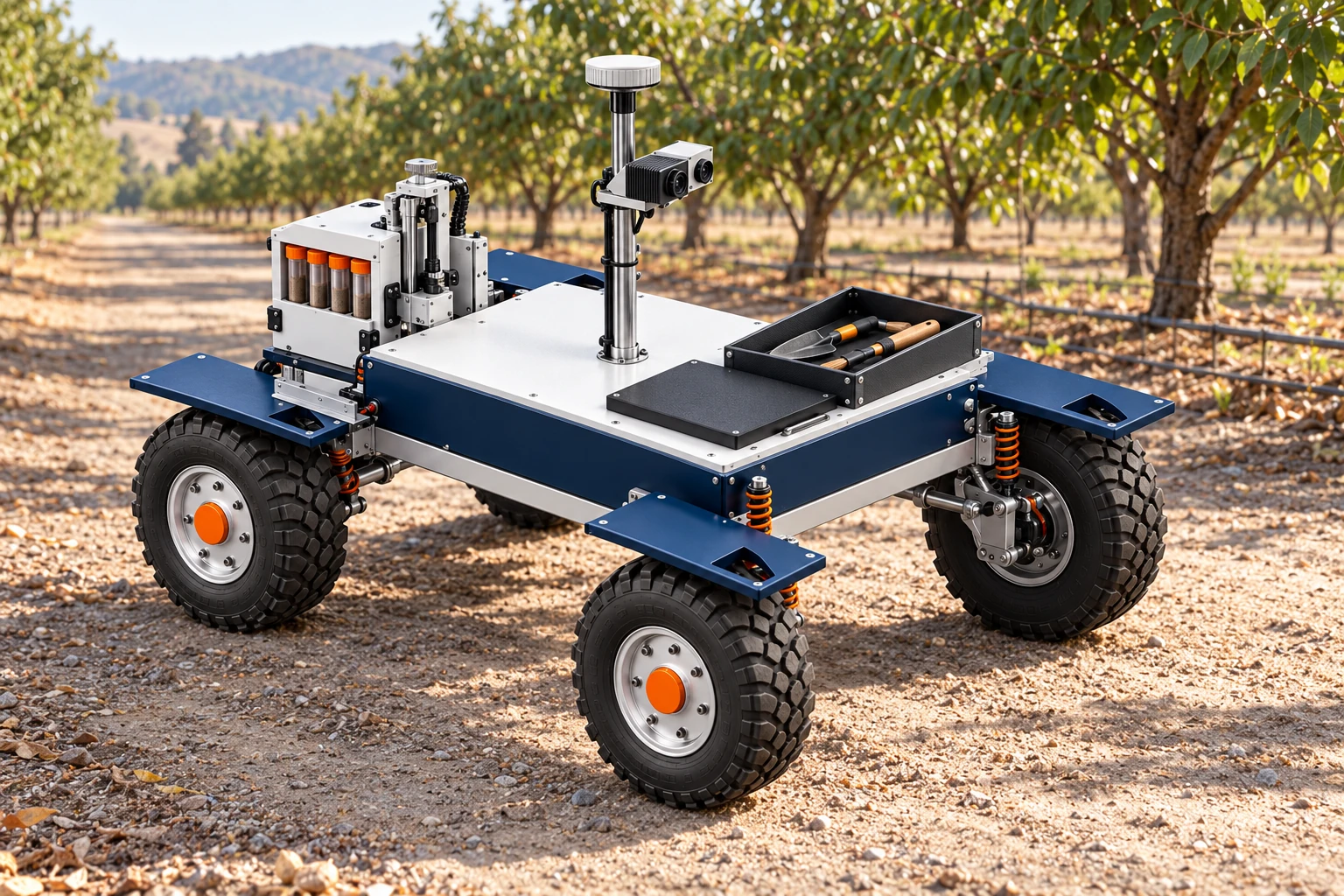
Only after land release, the platform could measure soil pH, electrical conductivity and moisture, and collect mapped samples for laboratory nutrient and contaminant analysis. Later tasks could include crop observation, irrigation checks and light farm utility.
Output: a basis for agricultural recovery planning
The ground platform
This earlier Concept A packaging reference explores independent double-wishbone suspension, inboard drive components and a wheel-supported forward sensor assembly. Revised ground-clearance and mobility requirements are being studied separately.
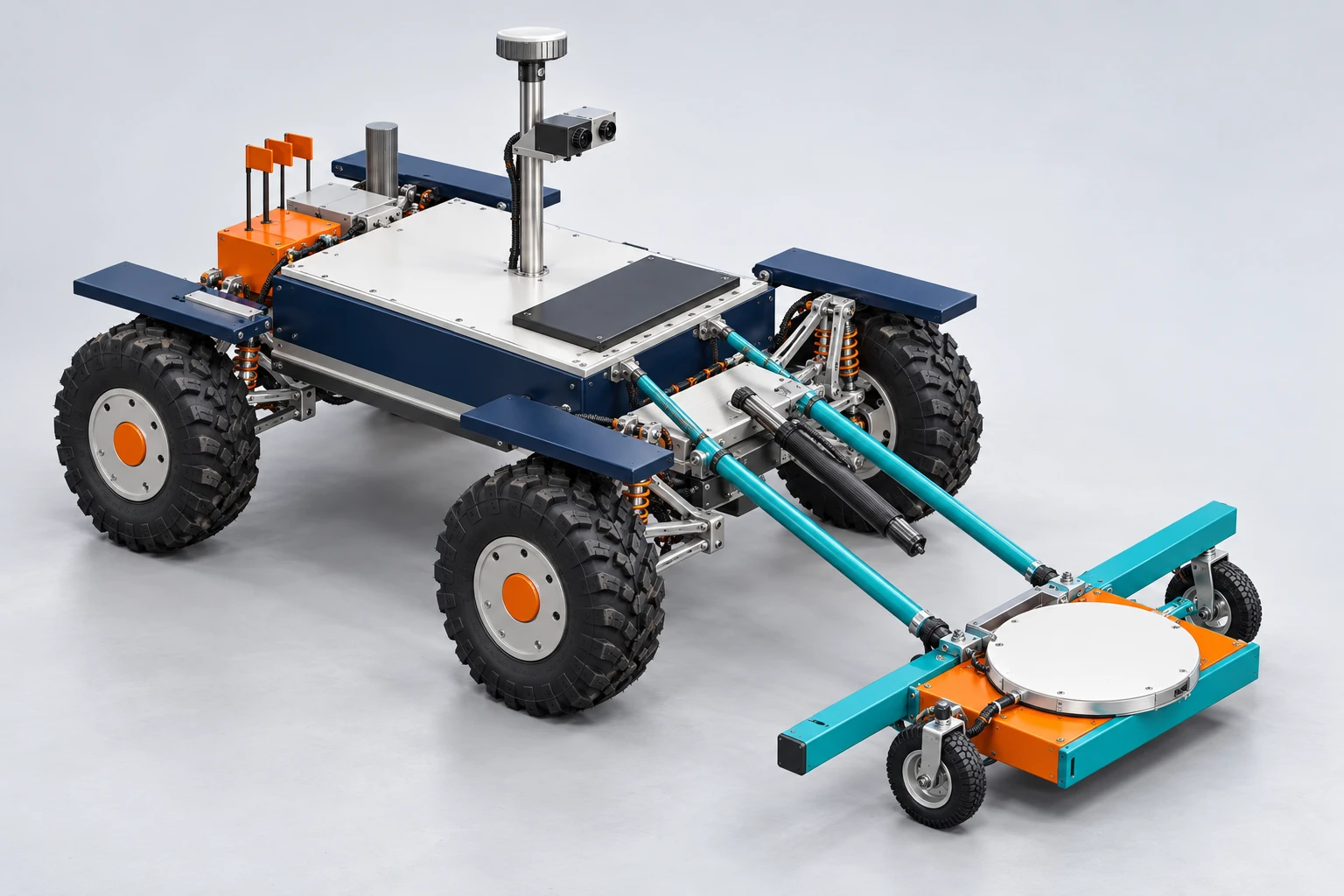
Two inboard 48 V axle motors drive differentials and half shafts, with proposed 2:1 portal reduction at each wheel. The revised concept proposes independent double-wishbone suspension at all four wheels, front Ackermann steering and non-steering rear wheels.
The proposed forward sensor assembly uses a floating connection and two support wheels, one on each side, to follow the ground. A lift would raise the assembly for transport. Head motion, support-wheel loads, sensor standoff, usable scan coverage and transport locking all require validation.
Onboard compute would support perception and evidence recording, with ArduPilot Rover proposed for supervised navigation and vehicle control. After land release and the appropriate task assessment, a reconfigured platform could support soil sampling, crop monitoring, irrigation inspection and light utility.
| Wheelbase / track | 1,200 mm / 1,000 mm |
|---|---|
| Tires / tire envelope width | 500 mm diameter × 150 mm / 1,150 mm |
| Forward traverse beam width | 1,400 mm; wider than the tire envelope |
| Body envelope | 1,400 × 700 × 350 mm |
| Overall length / mast height | About 2,700 mm with forward head / 1,350 mm |
| Reference static-clearance assumptions | About 250 mm below differential; 320 mm below body |
| Reference estimated mass: base / with soil module | 107.7 kg / 112.1 kg; preliminary design estimates |
| Gross mass case used in the earlier study | 140 kg assumed in that study; not a selected vehicle mass limit |
| Drivetrain concept | Two 48 V inboard motors; axle differentials; 2:1 portal hubs |
Engineering development
These reference layouts make the earlier Concept A packaging study reviewable. Ground-clearance and mobility candidates remain under analysis; any subsequent prototype testing would begin on known-safe terrain.

These native views and the STEP snapshot document Revision C of the earlier Concept A packaging study. The linked Onshape working models continue to evolve and require sign-in. The local dimensioned layout above is a separate reference illustration; the revised vehicle requirements remain under analysis.
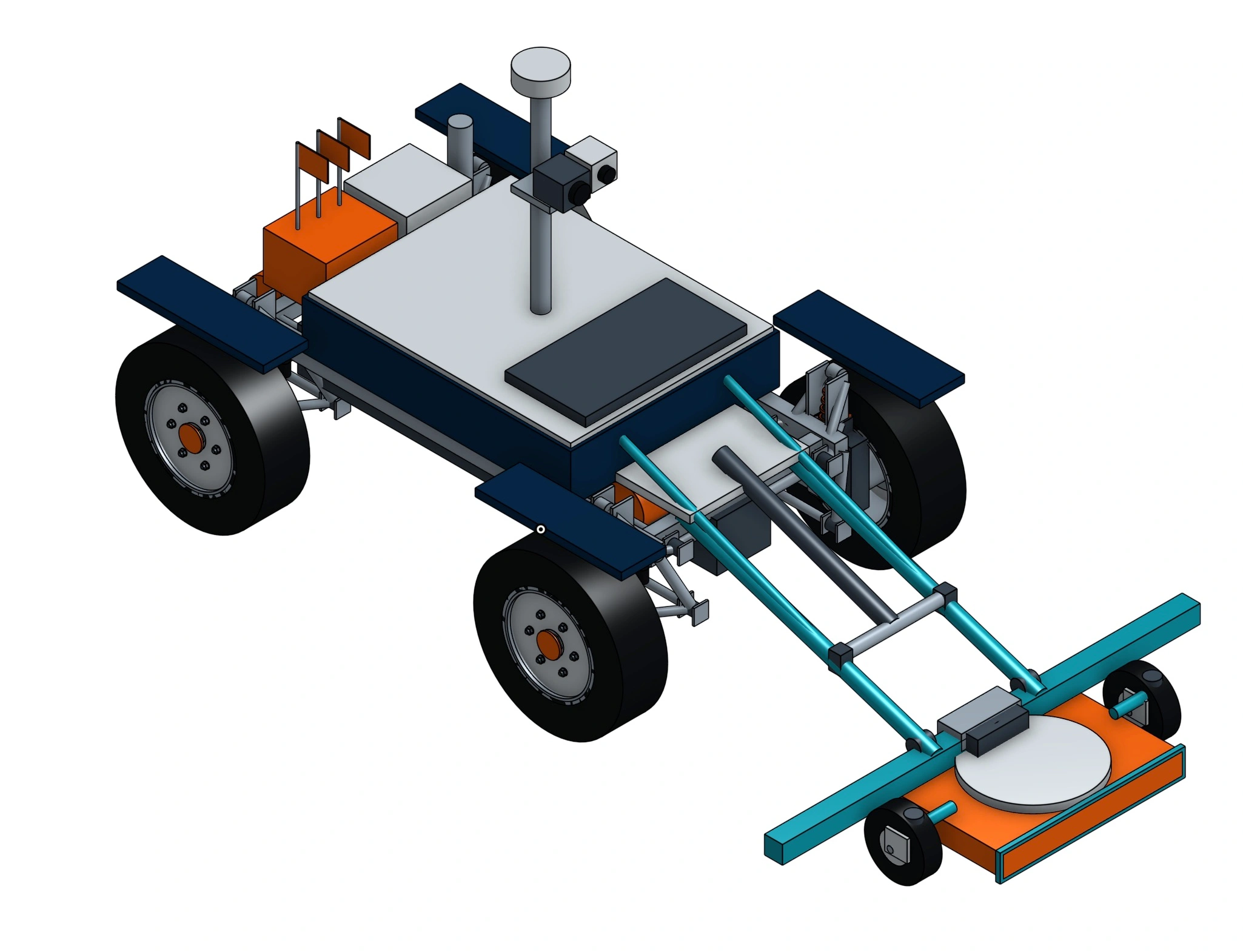
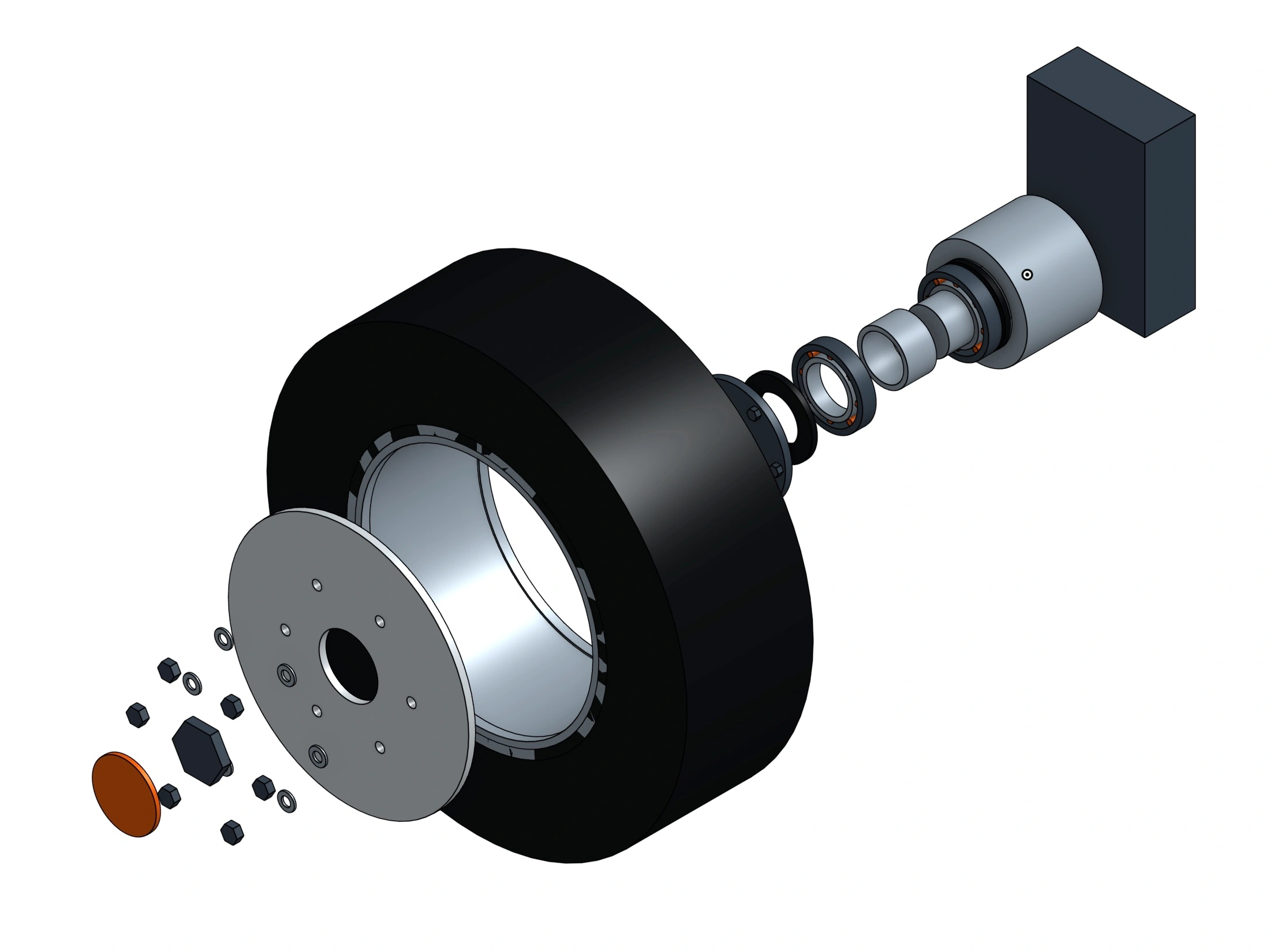
Conceptual packaging geometry. Articulation, ground clearance, structural performance and sensor compatibility remain unvalidated.
Confirm mass, center of gravity, stability, braking, turning envelope, wishbone joints, suspension travel, sensor-head float and lift motion, support-wheel loads, transport locking, sealing, thermal limits and service access.
Measure each sensor's limitations and combined performance across soil, moisture, depth and clutter conditions. Record false alarms, missed targets and incomplete coverage.
Develop supervision, communications-loss behavior, stop procedures, evidence review and field workflow with qualified partners before any hazardous-site use.
After land release
Formal release and agronomic suitability answer different questions. Nutrient status, soil structure and possible contamination can still shape what should happen next.
Mapped soil pH, electrical conductivity and moisture measurements, together with sampled material and qualified laboratory analysis, would inform a recovery plan. Crop monitoring, irrigation inspection and light utility could then extend the value of the same electric platform through the growing season.
Explore Edison's agricultural aviation →Build the evidence together
We welcome discussions with humanitarian mine-action organizations, sensor developers, robotics researchers, soil laboratories and agricultural partners.
Contact Edison Aerospace