
From the Lab · Gene Avakyan
Semantic Edge AI for Low Bandwidth Video Communication
Why I am building TRACE around observable events, evidence and uncertainty rather than a smaller video stream alone.
A remote camera can collect far more information than a constrained connection can carry. At Edison Aerospace, I am approaching that mismatch through TRACE, our semantic edge communication project. The idea is to process observations near the sensor and communicate evidence relevant to an operator's question. For remote inspection, environmental monitoring or disaster response, a useful report may be a supported change in the scene rather than an uninterrupted view of every pixel.
Conventional video compression remains valuable. It reduces the data required to represent images. Semantic communication asks a different engineering question: what information must reach the receiver for a particular task, and what context must accompany it? I see the opportunity in connecting those questions. A compact report only earns its place if the recipient can understand its basis and its limits.
An object is not an event
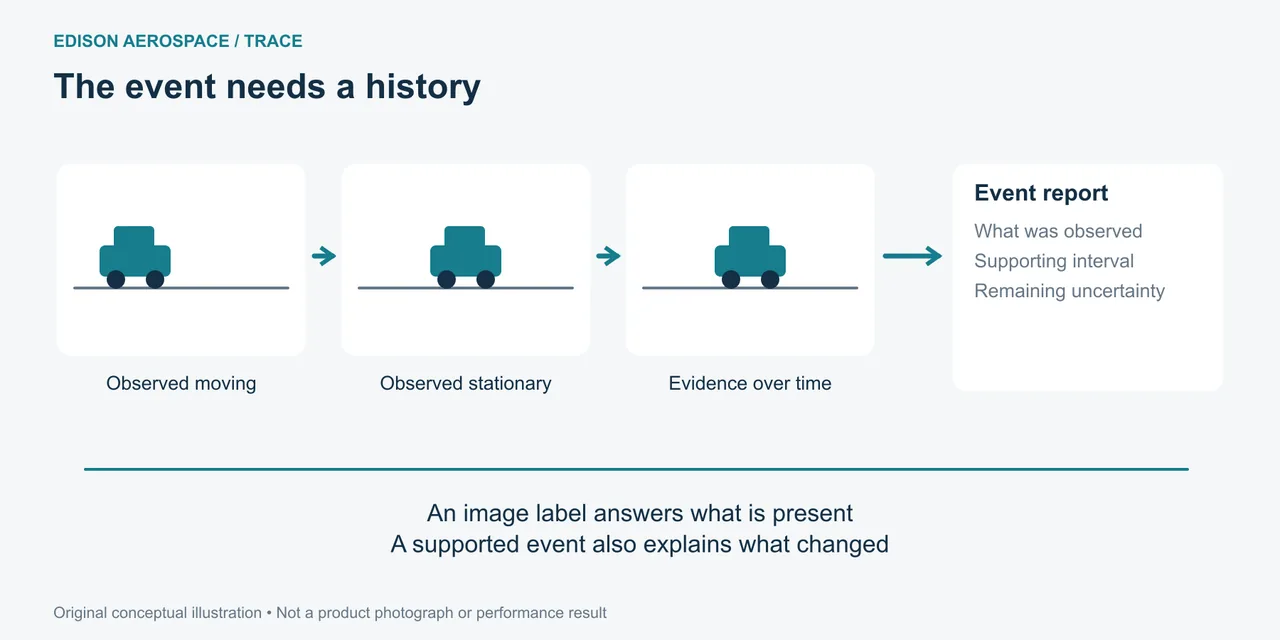
Our recorded-video development work illustrates the distinction. Recognizing a passenger car does not establish that it moved and then stopped. That conclusion depends on a sequence of observations. A vehicle that was stationary throughout the recording should not automatically satisfy a rule about a newly completed stop. Edge AI therefore needs more than a label on an image; it needs enough temporal context to distinguish the event from a superficially similar scene.
This is why TRACE connects perception with explicit event conditions. The intended output should identify what was observed, when the supporting evidence occurred and where uncertainty remains. If visibility breaks down, the system should not treat an unseen interval as proof that a condition continued. That choice may withhold a report that turns out to have been correct. I consider that tradeoff preferable to presenting unsupported continuity as a fact.
Bandwidth savings must preserve useful evidence
Sending fewer bytes is straightforward if enough information is discarded. Preserving useful evidence is harder. A short event description can omit the very context a reviewer needs to challenge it. Our proposed approach therefore combines concise reports with selected supporting visual information and a traceable record of the observation. The appropriate balance depends on the task and the available connection.
There are linked tradeoffs in bandwidth, latency and power. More analysis at the edge can reduce communications demand but consume processing time and energy. Sending richer context can improve reviewability while increasing delay. A system that makes good decisions on recorded footage may still be too slow for a live workflow. These are reasons to evaluate the complete path from observation to useful receipt, rather than treating compression ratio as the product's defining result.
The receiver also needs an honest account of what is missing. A report arriving intact establishes that those bytes survived delivery. It does not establish that the original interpretation was correct, that no important event was omitted or that the radio link will behave the same way in the field. Keeping those claims separate is part of making semantic communication trustworthy.
What our bench work supports
TRACE's preliminary work includes recorded-video runs on embedded computing boards, temporal event reporting and checks that a compact semantic stream can be reconstructed at a receiver. We have also compared that stream with selected full-frame video encodes. The results support a bounded feasibility argument: event-oriented communication can be implemented and examined on small computing platforms.
They do not establish general event accuracy or field readiness. The examples were development recordings, not a new independently scored evaluation set. The more complete processing path did not keep pace with its input replay rate, and the current stream exceeded the tightest simulated link budgets. Those findings matter because they identify work still needed in processing efficiency, prioritization and evaluation. A smaller file is not, by itself, evidence of equivalent decision quality.
A useful report should remain open to challenge
My next question is how reliably the system handles unfamiliar scenes, including cases where the correct response is uncertainty. Evaluation needs to count missed events as well as false reports and examine whether a reviewer receives enough context to make a sound judgment. That is a more demanding standard than showing a few successful detections.
I want TRACE to make limited connectivity more useful without making the evidence less accountable. For me, semantic edge AI succeeds when it helps someone understand an observation, inspect its support and recognize what remains unknown. That is the engineering reasoning behind this proposal and the standard against which I intend its development to be judged.