
From the Lab · Gene Avakyan
Multicore Sensor Fusion Needs More Than Faster Processors
The reasoning behind LATTICE and why I treat latency, consistency and evidence quality as one engineering problem.
Sensor fusion combines observations from different sources into a more coherent view of a changing environment. The difficulty grows when those sources produce data at different rates and the computing system cannot keep up. Through LATTICE, Edison Aerospace's proposed multicore sensor fusion research, I am examining a basic question: can more work happen concurrently while the combined result remains coherent and useful?
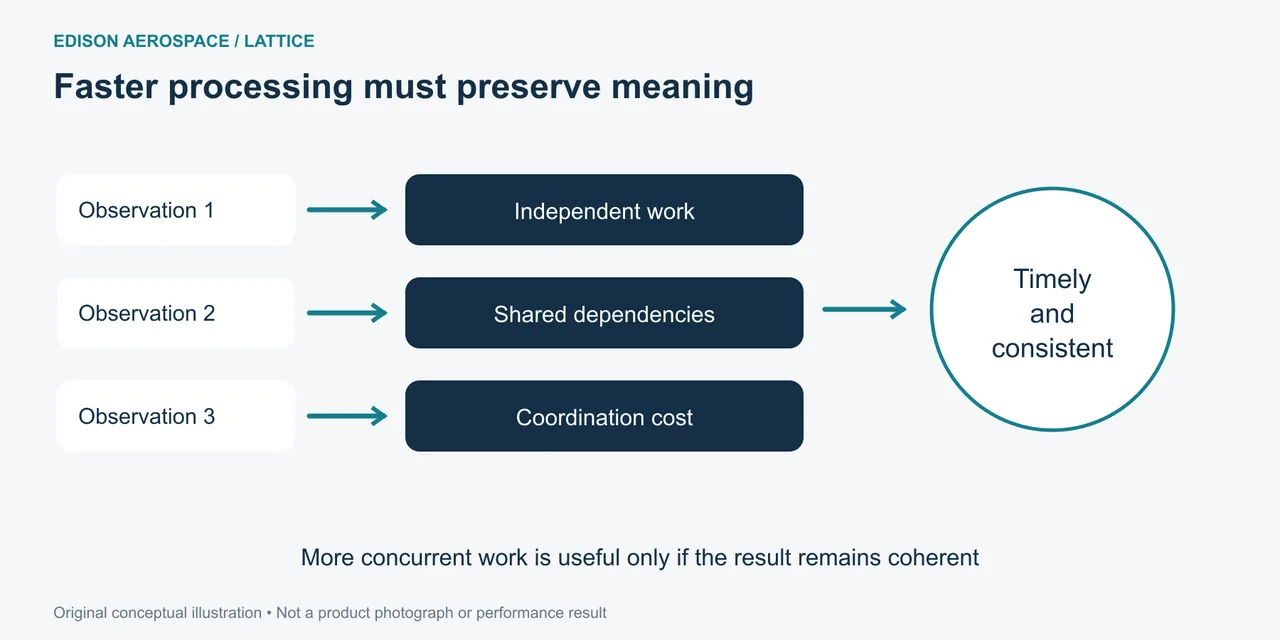
The proposal responds to a Navy research topic, but the underlying computing issue is recognizable across aerospace, robotics and industrial sensing. Data that arrives too late may be less useful even when its individual measurements are accurate. At the same time, discarding observations to maintain speed can remove information the system needs. I view that tension as the central problem, rather than assuming a faster processor will resolve it.
Why adding cores is not enough
A multicore processor offers several places for computation to run. Software benefits only when useful work can be divided and coordinated. If each operation must wait for the previous one, much of the additional hardware can remain idle. If work is divided carelessly, the system may spend its time moving data, waiting for shared resources or reconciling incompatible updates.
The broad idea behind LATTICE is to examine the organization of the work around sensor fusion. Some processing can proceed independently; other parts depend on information that is still being updated elsewhere. Recognizing that difference is essential. Concurrency is valuable when it shortens the path to a trustworthy result, not simply when it makes processor activity look impressive.
This leads to a practical tradeoff. Small units of work can expose more opportunities for parallel execution, but coordinating them has a cost. Larger units can reduce that cost while limiting how much work happens at once. The proposal treats that balance as a research question. It does not assume that dividing a workload into more pieces automatically improves the outcome.
A fast answer still has to be coherent
Different sensors do not necessarily describe the same instant. Nor do parallel computing tasks necessarily finish in the order in which observations were collected. A fusion system therefore needs to distinguish observation time from processing time and preserve the meaning of information as it moves through the system. Otherwise, a quicker update can still present an inconsistent picture.
That is why I consider data integrity alongside latency. A performance claim is incomplete if it counts faster processing but ignores lost observations or degraded consistency. The meaningful question is whether the system delivers useful information sooner under a comparable workload. This changes how I think about progress: speed and fidelity must be discussed together, with the conditions of the comparison made clear.
It also keeps the physical platform in the discussion. Additional computing capacity brings power, thermal and integration demands. An approach that looks attractive on a development workstation may behave differently on compact hardware. Our research concept recognizes that gap; predictions about a future platform should remain predictions until supported by measurements on appropriate equipment.
Measure the change rather than the promise
The proposal calls for examining the execution structure while keeping the underlying fusion problem comparable. I want to know whether a change in how work is organized produces a meaningful improvement, rather than confusing that effect with a different workload or a different interpretation of accuracy. That is the reasoning behind making comparison and reproducibility central to the research.
Simulation has a useful role in exploring possibilities, but a model does not become a hardware result because it produces a precise number. Its assumptions and relationship to measured behavior need to remain visible. Likewise, an average processing time can conceal periods when a system falls behind. Understanding those limits is part of assessing whether an apparent gain will matter outside a favorable example.
The standard I want the research to meet
LATTICE is a proposed research effort. I am not presenting it as a deployed system or claiming that a latency reduction has already been demonstrated. The value of this stage is to make the hypothesis clear and identify the conditions under which it could succeed or fail. Coordination overhead, inconsistent updates and differences between development and deployment hardware all deserve explicit attention.
For me, the broader lesson is that computing performance is inseparable from information quality. Multicore sensor fusion should help a user receive a dependable view sooner. If the design gains speed by quietly weakening the meaning of that view, it has missed the point. Our proposal begins with that constraint and asks what concurrency can responsibly contribute.