
From the Lab · Gene Avakyan
Heavy 1 Electric Agricultural Aircraft and Field Operations
Why a useful spray payload, field charging, and remote operation must be engineered as one agricultural aviation system.
Aerial application asks an aircraft and its operator to work close to terrain, crops, wires, and changing weather. Conventional fleets also carry the cost and logistics of fuel, engine maintenance, and seasonal utilization. At Edison Aerospace, we are developing Heavy 1 to test a different operating model: a full-size electric, fixed-wing agricultural aircraft flown remotely as part of a deployable field system. The goal is to preserve a commercially useful spray mission while moving the pilot out of the aircraft and changing how the fleet is powered and supported.
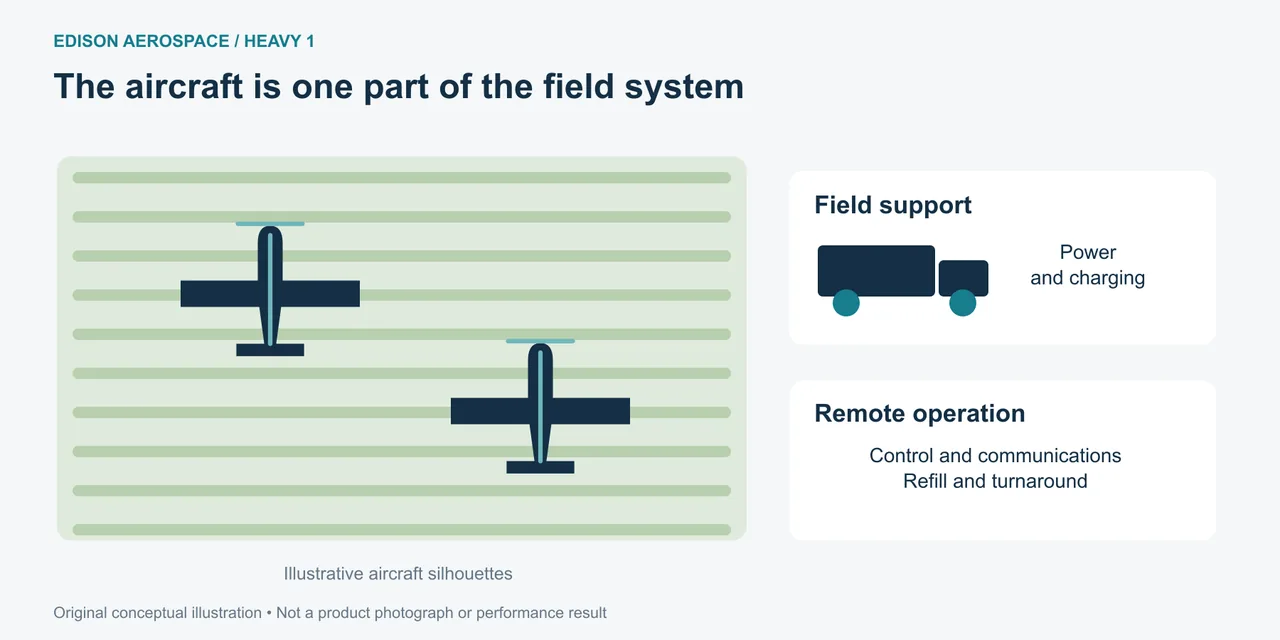
That goal needs careful qualification. Remote operation changes the pilot's exposure to an onboard crash, but it does not remove the need for pilot judgment, reliable command links, obstacle management, or regulatory approval. Electric propulsion can eliminate fuel burn at the aircraft, while total environmental and economic performance still depends on electricity generation, batteries, utilization, and support equipment. We treat those as engineering and operating questions to measure, not benefits already proven in service.
A useful payload sets the design constraints
Our current Heavy 1 concept targets a commercially substantial liquid payload in a full-size fixed-wing aircraft. Payload and endurance remain engineering targets to validate in flight. Payload matters because agricultural operators sell work completed across fields, not aircraft time in isolation. A small electric aircraft may be easier to build, yet frequent refills or limited coverage can erase its apparent advantage. Heavy 1 starts from the scale of work an established spray operator needs to perform.
The sizing creates a real tradeoff. Liquid payload, battery mass, reserve energy, and aircraft structure all compete within a fixed takeoff-weight envelope. A larger battery may extend flight time but reduce useful payload; a larger tank is only valuable if the aircraft can lift it and complete the planned mission safely. Spray equipment and battery performance also have to be evaluated across the mission rather than at a single attractive operating point. Our engineering task is to find a credible balance, then verify it with loaded aircraft, realistic routes, and turnaround measurements.
The ground station is part of the product
Heavy 1 is planned as more than an aircraft sale. Our typical proposed customer package is two aircraft with one mobile power and ground-control station. The station is intended to support field charging, mission control, transport, and fleet operations. That architecture reflects a simple operational fact: an electric aircraft that cannot recharge and turn around where spraying happens is not a practical replacement for a conventional machine. The second aircraft could help an operator organize work while one aircraft is being serviced, but actual throughput depends on charging time, refill time, crew procedures, and the available power source.
Remote piloting brings another system tradeoff. Moving the pilot to a ground-control station can improve physical separation from flight hazards, but it places more weight on situational awareness, communications, procedures for a lost link, and coordination with people on the ground. An operator needs to know what the aircraft will do when a command path degrades, and regulators will need evidence for the exact configuration and operation proposed. The aircraft, control station, energy supply, and operating procedures therefore have to mature together.
What would make the concept credible
We have displayed a Heavy 1 prototype at an agricultural aviation convention and have reported letters of intent or interest from spray operators and interest from a USDA Agricultural Research Service field laboratory. Those signals help us understand demand; they do not establish certified performance, paid adoption, or a production-ready aircraft. The next useful commercial proof point is a paid prototype evaluation with agreed criteria that a customer can observe.
For me, the decisive evidence would connect the engineering targets to a complete day of work: measured payload and endurance under representative conditions, safe remote operation, refill and recharge times, energy use, maintenance needs, and acres treated at an acceptable application quality. That evidence would then inform the certification path, manufacturing design, and customer economics. Heavy 1 remains in development, with progress dependent on engineering, capital, regulatory work, and production readiness. We are designing toward a more capable electric agricultural aviation system, and the measurements will determine where it truly fits.