
From the Lab · Gene Avakyan
MOSAIC Autonomy Assurance for Accountable Robotics
A proposed assurance approach for finite tasks, safe closure, and evidence-based debriefs in combat robotics.
An autonomous machine can keep moving after the instruction that started its work has become stale. A clock can expire, an inspection can finish, or a safety condition can change while the machine is already in motion. The engineering question is more precise than whether a stop message was sent: what work was authorized, when did that authority end, what did the machine observe, and did it reach an appropriate safe condition?
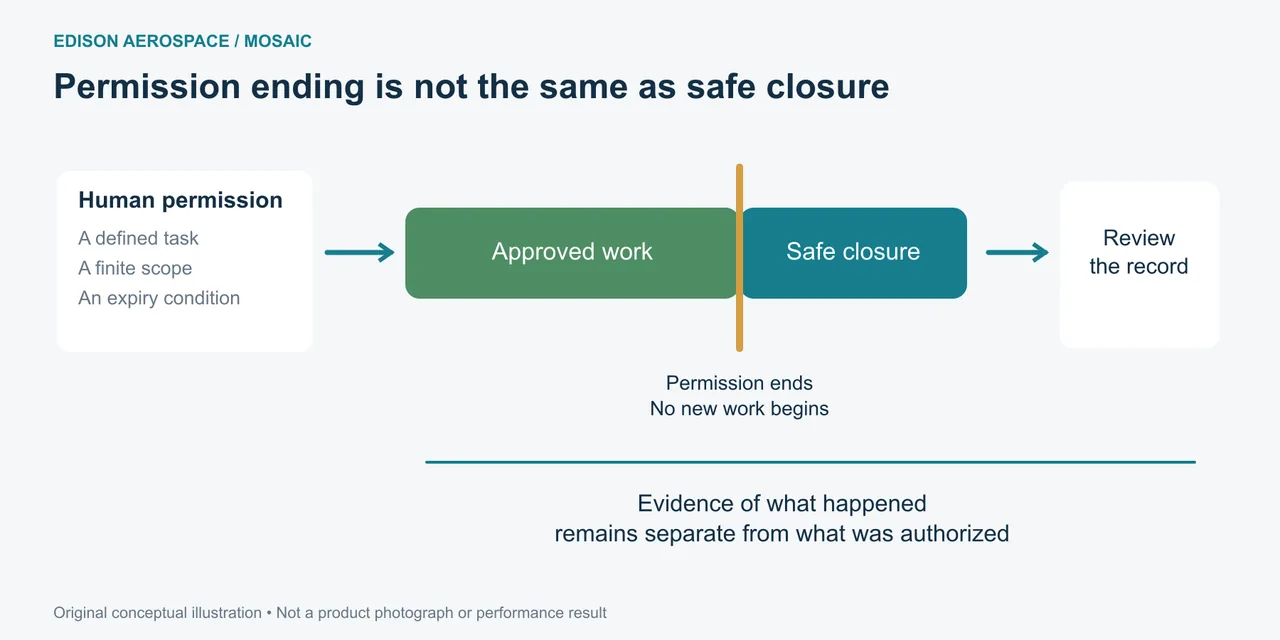
At Edison Aerospace, I am proposing MOSAIC to make that chain reviewable for combat inspection and material handling. The idea is to connect a human-approved permission to the machine’s recorded actions and to a structured debrief. The initial focus is an offline assurance study using simulation and permitted records. MOSAIC is a concept, assessed at technology readiness level 2. We have not built an integrated prototype or measured its performance.
Finite permission has two endings
A useful permission should identify the approved task, its time window or completion condition, the safety conditions that must remain true, and the expected response when permission ends. Consider a warehouse robot told to inspect five shelves. Completing the fifth shelf ends permission to start more inspection. It does not magically place a moving robot in a safe state. Ending permission for new work and safely closing an action already underway are related but separate events.
That distinction matters when a command arrives late or a connection fails. A cancellation transmitted by a supervisor is not proof that the robot received or acted on it. A system should preserve the difference among sent, acknowledged, and observed outcomes. Nor should autonomy grant itself another round of work after a finite task finishes. Renewal requires fresh human approval. The exact safe response depends on the platform and operating environment, so it must be assessed with the equipment’s existing safety controls.
Turn the record into a defensible debrief
MOSAIC would organize evidence around the version of the instruction that applied at the time. A reviewer would see available inputs, recorded decision criteria, acknowledgments, observed actions, outcomes, and gaps in the record. This structure could help distinguish a poorly framed instruction from a bad input, a noncompliant decision, an execution failure, or simply insufficient evidence. Those are different problems and call for different remedies.
The debrief must say what the record cannot establish. Missing timestamps or inconsistent clocks can defeat a confident sequence of events. Unlogged reasoning remains unknown. A simulated replay of an alternative choice can help explore a question, but it is not proof of what would have happened in the physical world. A report should cite the supporting records for each conclusion and mark unresolved questions plainly. That is the basis of evidence-based debriefing, rather than a polished story that outruns its data.
Build on existing tools test the added value
Robot lifecycle controls, event recording, and manual log review already exist. MOSAIC does not claim to invent expiration or state machines. Its proposed contribution is a common, testable link between task permission, safe closure, and the evidence a reviewer needs across different equipment suppliers. That link may prove useful only if it improves review quality enough to justify integration effort.
The proposed first study would examine ordinary edge cases: permission expiring before a task begins or while work is underway, finite completion, a renewed instruction, a lost safety condition, delayed cancellation, restart, and missing records. An independent reviewer would compare the system’s classifications with an adjudicated case set. We would also compare review effort with raw logs and a checklist. These are planned evaluations, not completed tests or validated safety results.
A careful path from concept to use
I see an initial role for an offline debrief application used by warehouse robot integrators, industrial inspection operators, and combat logistics test teams. It could import supported records and produce a traceable report without replacing the installed robot controller. Before any physical pilot, Edison would need reliable access to records, trustworthy capture, reproducible review, and independent safety expertise. Successful log review alone could never certify that a machine stopped safely.
If MOSAIC advances, its value will be measured by whether people can answer concrete questions faster and with fewer unsupported conclusions. The practical value of an integrated MOSAIC product remains to be demonstrated. The proposal sets out the research needed to learn whether this assurance layer deserves a place in real operations.